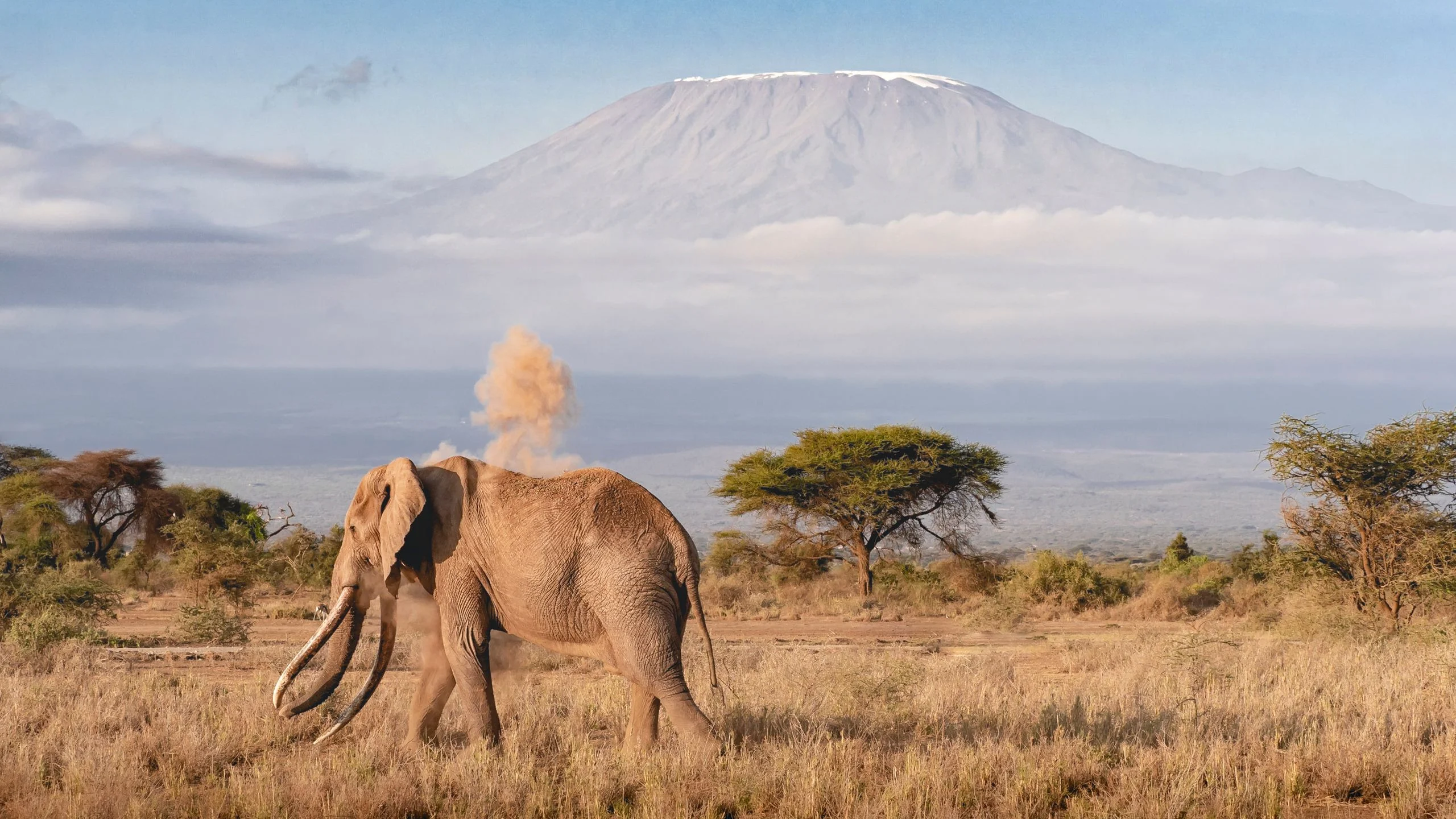
Amboseli gives you one shot that nowhere else in Kenya can: big-tusked elephants walking across open plains with the snow-capped dome of Kilimanjaro filling the frame behind them. I’ve guided this park more times than I can count, and the mountain being visible at all is the one thing you can’t fully control. Here’s how to give yourself the best odds and get the shot right when it happens.
The mountain is shy: plan around it
Kilimanjaro generates its own weather and is frequently cloud-covered by mid-morning, even in clear conditions elsewhere in the park. Your best chance of a clean view is at first light, roughly 6.30-8am, before clouds build up around the peak. By 10am on most days, even in the driest months, the summit is wrapped in cloud. If a clear-mountain shot is your priority, tell your guide before the drive starts so the route is planned around Kilimanjaro-facing vantage points early.
Best months for a visible summit
January-February and June-October are the driest months and give the most consistent mountain visibility, especially at dawn. The March-May long rains bring dramatic cloud formations that can still produce striking shots, but you’ll wait longer for a clear gap.
Where in the park to be
The Sinet Swamp area
This wetland area draws large elephant herds throughout the day thanks to permanent water, and it sits with a strong sightline to the mountain on clear mornings, one of the most reliable combinations in the park.
Observation Hill
A short walk (permitted here, unlike most of the park) up Observation Hill gives you an elevated wide-angle view over the plains with Kilimanjaro as backdrop, useful for scale shots showing herds against the full landscape rather than tight portraits.
Near Ol Tukai and the central plains
The open plains near Ol Tukai Lodge and Amboseli Serena Safari Lodge are classic elephant territory and align well with the mountain from most vehicle tracks: this is the view you’ve seen in most Amboseli photographs.
Insider tip: Get low. Ask your guide to park with the vehicle roof hatch pointed toward the mountain and shoot from a lower position through the window rather than standing: it puts more mountain and sky in frame and less foreground grass.
Composition for the classic shot
- Use a wide-to-medium zoom (24-70mm equivalent) to fit both elephants and mountain, rather than a long lens that crops the peak out
- Place the mountain in the upper third of the frame and let the elephants and plains fill the rest
- Shoot in silhouette at golden hour for dramatic contrast, or expose for the elephants and let the mountain go slightly soft in haze
- Watch for dust: elephants kick up fine reddish dust that catches side-light beautifully in the low sun
Camera settings for this specific scene
Because you’re often shooting a bright sky (mountain) alongside darker foreground subjects (elephants), use spot metering on the elephant rather than the whole scene, or bracket exposures if your camera supports it. Shutter speed of 1/1000s handles most elephant movement; slower is fine if they’re grazing calmly. For broader settings guidance, see our safari photography basics for beginners.
Combining it with the wider circuit
Many guests pair Amboseli with a wider loop: our Amboseli Under Kilimanjaro 3-day safari is built specifically around maximising time in the golden hour windows, and it pairs well with a Tsavo West and Amboseli combination if you have five days rather than three.
Quick answers
What time of day is best for the Kilimanjaro shot? Before 9am, ideally 6.30-8am, when cloud cover is lowest.
Which season gives the clearest mountain views? January-February and June-October are your best odds, though nothing is guaranteed with an equatorial mountain that far in height.
Do I need a long telephoto lens? No: a wide-to-medium zoom captures both elephant and mountain better than a long lens, which crops the peak out entirely.
Is Amboseli good for anything besides elephants? Yes, it has strong birdlife around the swamps and excellent zebra and wildebeest numbers, but elephants against Kilimanjaro remain the signature shot.